Perspectives
You already practice Project Intelligence. OPUS helps you go further.

How construction and real estate teams use project records, professional judgment and OPUS monitors to spot risks and make better-informed decisions.
For the past five years, we have been helping construction and real estate professionals build a unique source of truth for their projects. Our aim is to address miscommunication, make project information reliable, and ensure that everyone working on a project can access the information they need, when they need it.
But as we spend time with our clients and observe how they work, we find ourselves asking a broader question. Beyond solving miscommunication, how are we helping them?
Some of the answers emerge when we sit alongside architects and their clients during project meetings.
These meetings are rarely theoretical exercises. They are pragmatic discussions intended to move a project forward. Participants bring their respective knowledge, confront their perspectives and attempt to reach a common understanding from which a decision can be made.
Sometimes, a single piece of evidence brought to the table changes the perspective of everyone in the room. A document, a previous decision, a technical observation or a commitment made weeks earlier can fundamentally change the direction of a discussion.
Information brought forward at the right moment drives decisions.
This is Project Intelligence. It predates OPUS. You have been practising it throughout your entire professional life.
What we are questioning today is how far you could take it.
I. The limits of what you can know
When information becomes noise
Every professional working on a complex project faces an increasingly difficult reality: there is more information being produced than they can reasonably process.
To cope with this volume, we naturally filter information. We pay attention to what appears important at a given moment and disregard what seems less relevant. This is not necessarily a professional shortcoming. It is a human necessity.
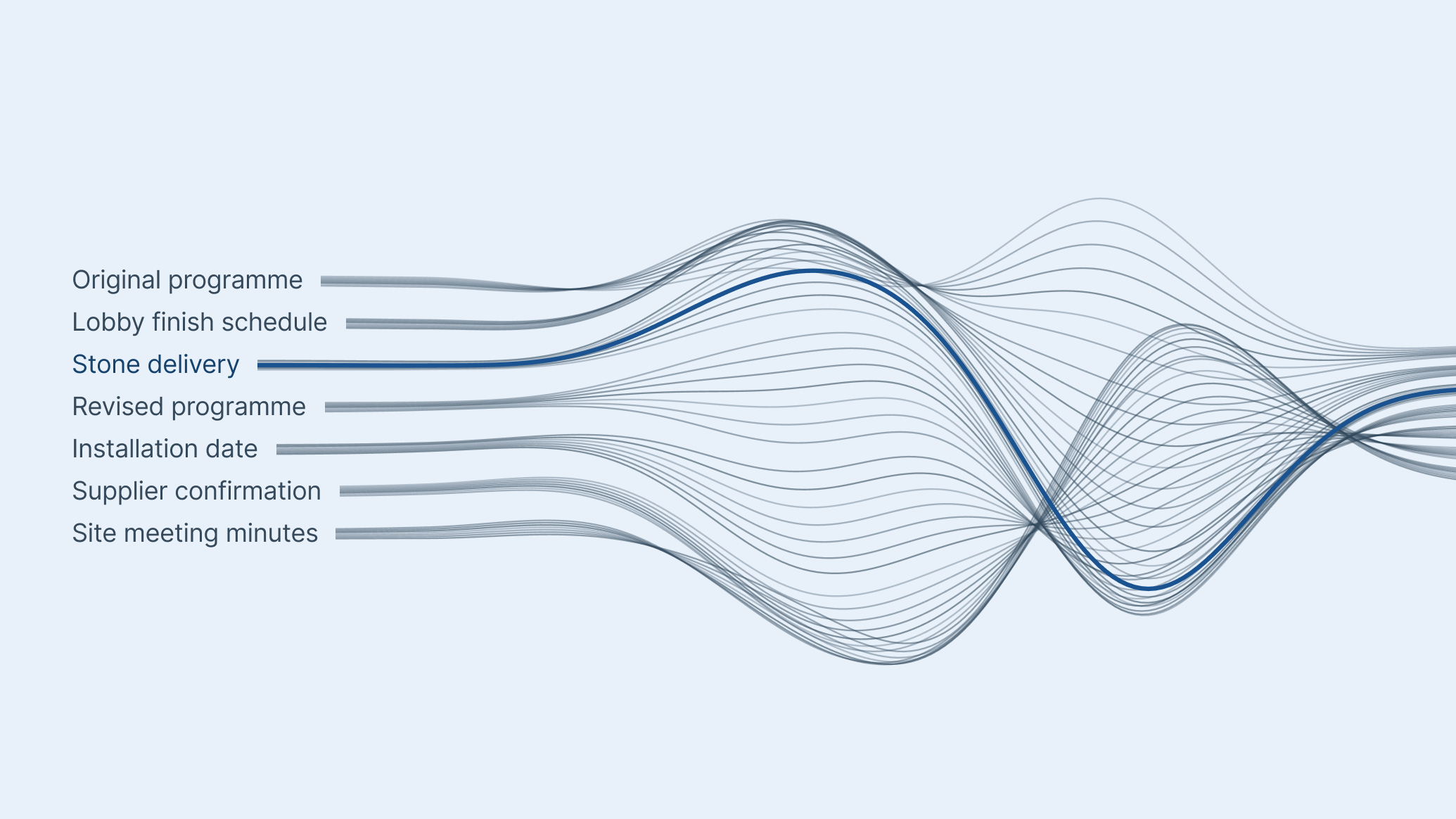
The difficulty is that the significance of information is not always apparent when we first encounter it.
Without a reliable project record, it becomes extraordinarily difficult to revisit the information we set aside and see whether we are overlooking something important.
There is also a growing paradox surrounding artificial intelligence. While AI promises to help us process information, it simultaneously accelerates its production. Documents, presentations, reports and communications that take hours to produce by hand can now be generated in seconds.
Our capacity to produce information is increasing. Our human capacity to process it is not.
This becomes particularly consequential in an industry where decision-making is inherently collective. Architects, engineers, designers, contractors and consultants all produce materials that fuel one another's reasoning. A technical approval, for instance, requires several professionals to reconcile their respective expertise and constraints around a common solution.
The intelligence of a project depends on their ability to bring those contributions together.
Information is not intelligence
Knowing that a stone delivery is scheduled for the end of November is information. Knowing that this represents a two-week delay is an insight.
The insight comes from comparing the new delivery date with the date on the original schedule.
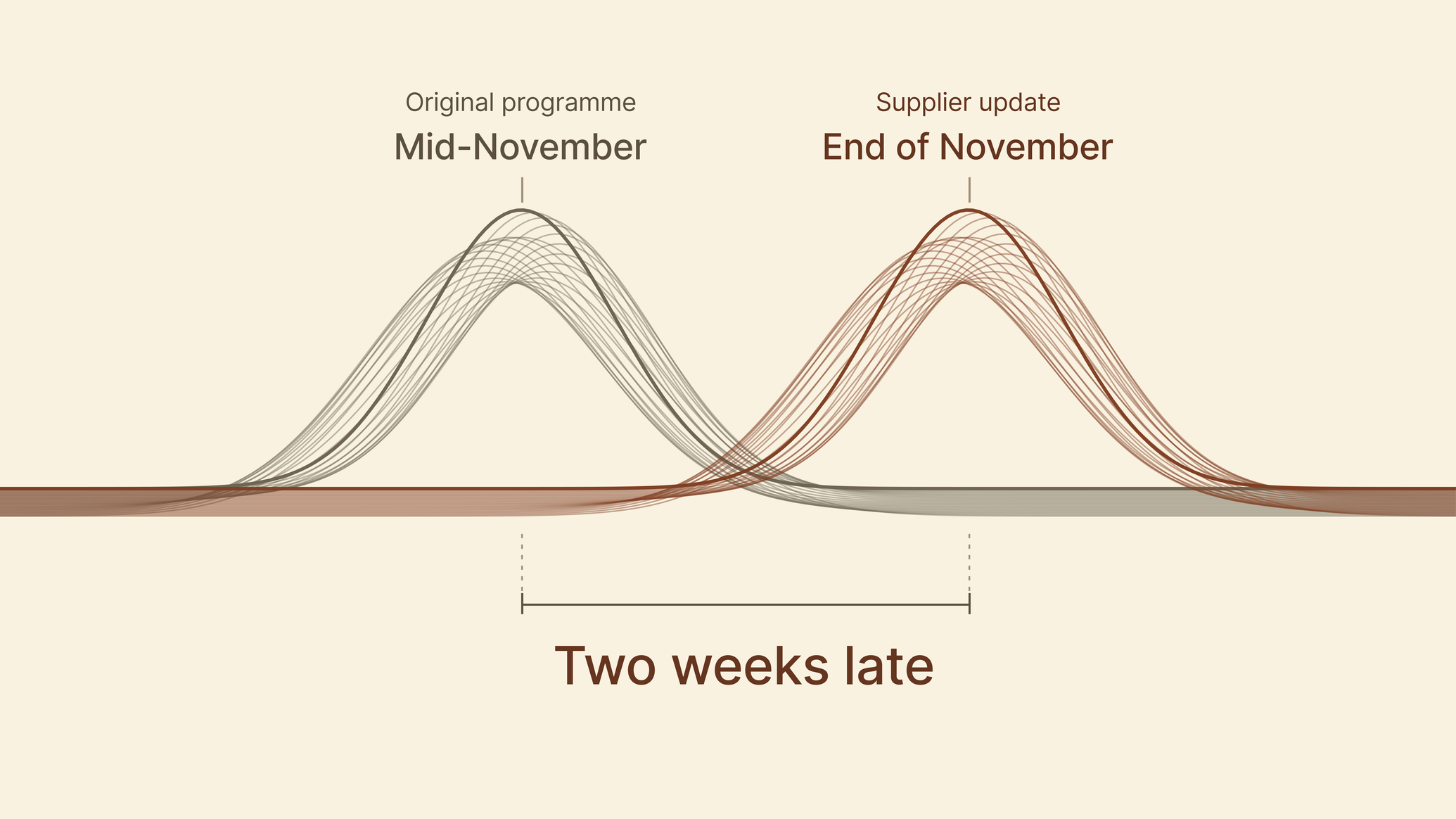
An insight tells us more than the information itself.
While an insight can sometimes emerge from a single piece of information, it often requires cross-referencing several sources, establishing relationships, developing a line of reasoning and confronting it with further evidence.
This requires time, intellectual effort and sometimes several attempts.
The most difficult insights to discover are often those that emerge from an accumulation of individually insignificant events. A succession of minor technical complications, each perfectly manageable in isolation, may progressively jeopardize a critical milestone.
To anticipate such a situation, one must first identify the pieces of evidence that could influence the project timeline, then construct a reasoning around them. Previous experiences and knowledge accumulated on other projects can help illuminate their significance.
The future is written in what is happening today. The difficulty lies in our ability to read it.
Intelligence is constructed over time
When we observe how experienced professionals acquire knowledge about their projects, we notice something fundamental.
They never start from nothing.
Experienced professionals do not arrive at the office every morning, open the entire project documentation and begin reconstructing their understanding of the project. They build that knowledge over weeks, months and sometimes years.
Information flows through time.
A professional investigating a particular subject may encounter a piece of information whose significance is not yet clear. They keep it in mind, waiting for further information that might confirm a suspicion, establish a relationship or reveal a consequence.
For us, it is essential that OPUS Project Intelligence reflects this dimension of human reasoning.
Consider the stone delivery again. When the supplier first reports a two-week delay, there may still be enough time before installation. A week later, the contractor revises the programme and brings the installation forward. Neither update mentions the other. An experienced professional who remembers the supplier’s message may recognise that the revised date is now at risk.
A model with access to the project record can reach the same conclusion if someone asks it to check the installation date. But what prompts anyone to ask that question again? We want OPUS to carry the earlier information forward, so that the revised programme brings the delivery delay back into consideration as soon as it becomes relevant.
This is where the OPUS Gatekeeper comes in.
The Gatekeeper is an agent that reads and processes project information as it flows into OPUS, continuously enriching the relationships through which project knowledge can be understood.
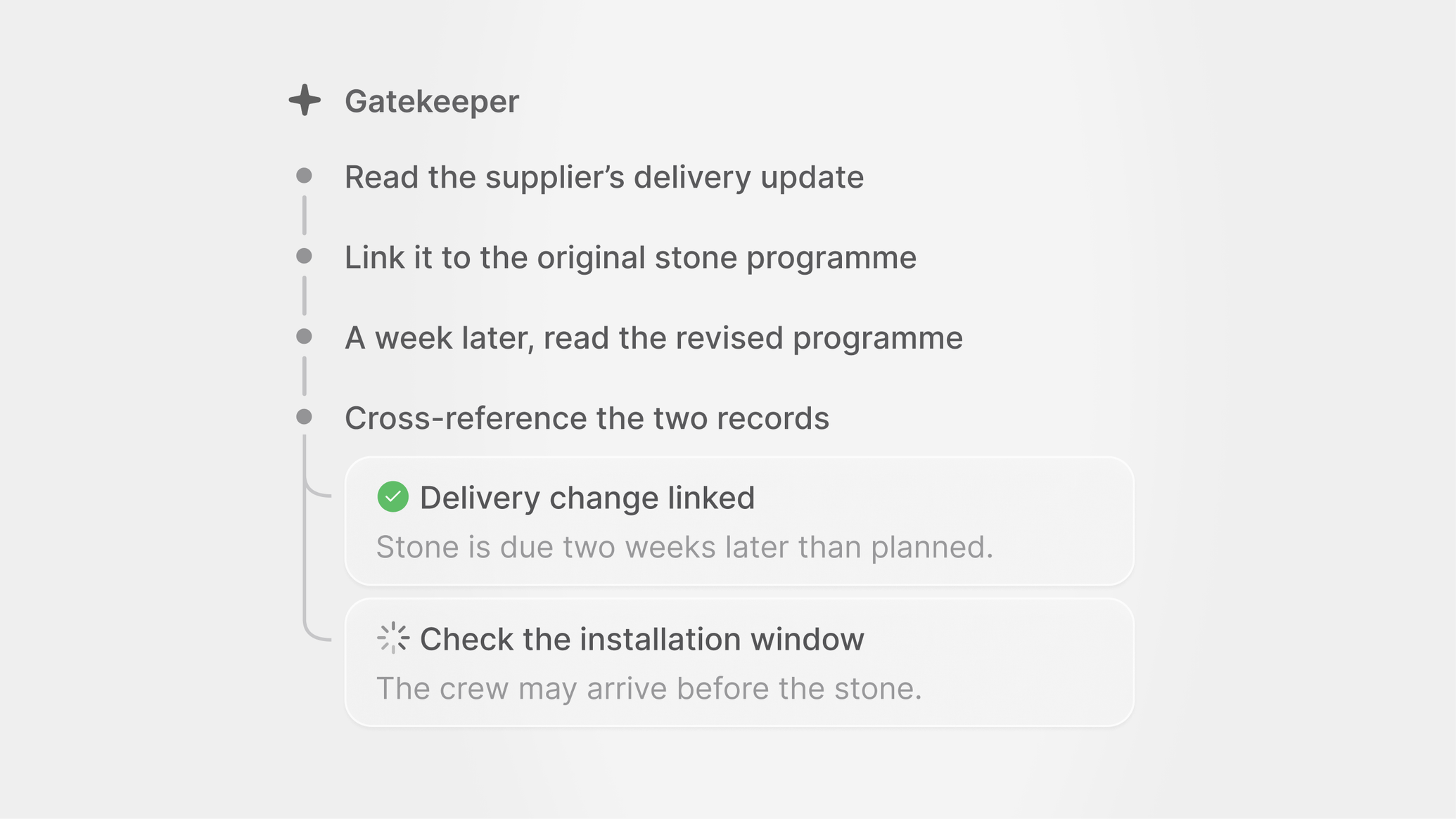
In doing so, we consider not only the raw information but also the information surrounding it.
Who writes the document? When does the team receive it? Who reads it? Does it replace an earlier version? How does it relate to other project materials?
These elements contribute to understanding the nature, context and weight of information. Reading a document without knowing that a newer version has replaced it, for example, can lead to an entirely incorrect interpretation.
By processing information throughout the span of a project, rather than exclusively at the moment a question is asked, we create an infrastructure designed to make even the most difficult insights discoverable.
For this to work, OPUS needs the full project record, and the information in it must be reliable.
We’ve spent the past five years focusing on building a source of truth for each project, bringing project knowledge together in one place and helping everyone involved use it.
This work lays the foundations for Project Intelligence.
II. Your unfair advantage is the way you look at your project
The dilemma of relevance
If technology allows us to overcome the limitations of information processing, we are immediately confronted with another challenge.
What should we actually pay attention to?
A system capable of producing hundreds of accurate insights every day would not necessarily make a professional more effective. It could simply reproduce the original problem of information saturation at the level of intelligence.
The Pareto principle offers an interesting perspective here. Rather than attempting to investigate every possible insight, we should seek to identify the relatively small proportion capable of making a substantial difference to the outcome of a project.
In our view, an insight derives its value from the decision it serves. It is valuable when it reinforces the basis of a decision or calls it into question.
Experienced professionals understand this distinction.
We have all encountered situations where considerable time and intellectual effort are dedicated to details whose significance is disproportionate to the greater cause they serve.
When an issue comes up on your project, your experience helps you judge whether it could put a contract obligation at risk, delay a milestone or push costs over budget.
Knowing what to investigate is important. Knowing what to ignore is equally so.
Knowing where to look, and how to look
What makes a professional capable of repeating success?
Throughout their career, professionals encounter situations, confront difficulties, make mistakes and discover that a problem can have no easy answer, and what works on one project may not work on another.
These experiences progressively shape their way of looking at a project.
Imagine asking several experienced hospitality developers what they believe could jeopardize the opening date of a hotel.
They would not necessarily give you the same answer.
Each would approach the question through their own experiences, convictions, sensitivities and understanding of what drives success. Each would establish different priorities and pay particular attention to different signals.
There is no single correct way to look at a project.
Of course, there are foundations of professional knowledge that we acquire through education and experience across an industry. But beyond those common foundations, what often makes people want to work with a particular professional is precisely the part of their analysis that is different.
That difference is their unfair advantage.
The same applies at the scale of a company. Over decades, organizations accumulate knowledge, data, experience and distinctive methodologies. Their competitive advantage resides not only in what they know, but also in how they look at what they know.
We believe this intellectual capital deserves to be preserved, developed and leveraged.
Take the hotel opening. If late deliveries have caused problems on your previous projects, you might ask us to watch for changes in delivery dates. Together, we can set up OPUS to flag a delivery that is now due after installation is meant to start. You decide which deliveries deserve that attention and what to do when a date changes.
Giving expertise the time it deserves
What prevents an exceptional professional from exercising the full extent of their expertise on every project, every day?
Time.
Too much of a professional's time is dedicated to searching for information, cross-referencing it and constructing insights. Too little remains available to think about what those insights actually mean.
There is a fundamental distinction between the time spent acquiring the materials for thinking and the time spent thinking itself.
The less time you spend finding and checking information, the more time you have to think about what it means for your project.
This conviction shapes the role of the Project Intelligence Engineer at OPUS.
Our Project Intelligence Engineers work alongside our clients to understand their distinctive ways of working. We use questions like these to understand what matters to each client and decide together what OPUS should watch for:
- What are you trying to achieve?
- What do you believe drives your success and needs to be preserved?
- What mistakes have you encountered repeatedly and want to avoid making again?
- Where do you look, and how do you look, when trying to anticipate a particular situation?
The answers are rarely identical from one client to another.
Our ambition is to understand these individual methodologies and develop the intelligence capable of supporting them. As we observe the results alongside our clients, we continuously refine our approach.
We are not attempting to standardize their expertise. We are attempting to extend its reach.
III. Materializing your Project Intelligence
From questioning to continuous intelligence
As we work alongside our clients, we notice which questions each of them keeps bringing back to the agent.
We wonder whether they should have to keep asking them.
These questions are often complex. To answer them, the agent needs to retrieve substantial amounts of information, cross-reference evidence and work through the reasoning again. Repeating these investigations takes both time and computational resources.
More importantly, the professional still has to remember to ask the question.
We want to rethink this approach.
Rather than periodically asking an agent to investigate a particular subject, why not investigate it continuously, as the information relevant to it arrives?
This is the purpose of our monitors.
A monitor is an agent dedicated to identifying insights according to a defined set of parameters. It is connected to the incoming flow of project information and processes it as it arrives.
When it discovers an insight of sufficient significance, it can bring it directly to the attention of the professional.
When it encounters information that may become significant later, it can retain it and cross-reference it with subsequent information, progressively constructing a more meaningful insight.
This allows professionals to delegate not only the search for information, but also the continuous intellectual effort required to discover the insights they consider important.
A Terminal that reflects your way of thinking
The OPUS Terminal is where this intelligence materializes.
It is the interface through which professionals can access the insights that matter to them, whether they are arriving at the office, preparing for a meeting or taking a moment to reconsider a situation on their project.
What you see in your OPUS Terminal depends on the questions you bring to the project.
We configure each OPUS Terminal alongside our clients, taking into consideration their objectives, responsibilities, expertise and convictions about what drives project success.
Two professionals working on the same project, with access to the same information, may have fundamentally different expectations of their Terminals.
And that is precisely the point.
The OPUS Terminal follows the questions each professional wants to investigate as new project information arrives.
Over time, as professionals discover the value of certain insights, reconsider their priorities and learn from new situations, their Terminals evolve with them.
That experience can also travel from one project to the next. Take the developer who watches for late deliveries before a hotel opening. On the next hotel, a colleague can use the same check in their OPUS Terminal, then adapt it to the installation dates and suppliers on that job. A lesson one person learns on site becomes a question the next team knows to ask.
Our ambition for the OPUS Terminal is clear. You choose the questions you want to follow. As the project record changes, the monitors look for evidence that changes the answer and bring it to your attention.
You judge what the evidence means and decide what to do next.
What does this unlock now?
Project Intelligence predates OPUS. We take it a step further by helping you follow those questions even when your attention is elsewhere.
Think of the architects, engineers and contractors who bring a hotel from its first drawings to the day it opens. That achievement depends on what each of them knows and the decisions they make together.
Our ambition is to remove some of the limitations that prevent them from fully exercising that intelligence.
Today, professionals seek greater performance, confidence and peace of mind. They want to anticipate difficulties, protect their projects and repeat their successes. These are already meaningful ambitions.
But perhaps there is something beyond them.
If professionals spend less time gathering the information they need, what new ideas do they have time to explore?
If every project team can draw on what its colleagues learn across decades of work, which projects might the organization now feel ready to take on?
And if we could push the boundaries of what human beings are capable of understanding, anticipating and orchestrating, what would we dare to build tomorrow?
These are questions we are only beginning to explore.